
“I want a pet but I rent. My lease has restrictions, my walls are thin, my space is small, and I can’t afford to lose my deposit.” If that’s you, this guide was written specifically for your situation.
I grew up in a small village with grandparents who kept cows, horses, donkeys, rabbits, chickens, cats, and dogs. I know what it’s like to be surrounded by animals. I also know what it’s like to move into a 400-square-foot apartment and realize that most of those animals are absolutely impossible in that context.
This guide is written for renters. Not pet owners with houses and yards and flexible landlords; renters with lease restrictions, shared walls, security deposits on the line, and real space limitations. The advice here is honest about all of those constraints, because pretending they don’t exist doesn’t help you.
A few things this guide covers that almost no other apartment pet article does: which animals most leases don’t even classify as “pets” (meaning no deposit, no pet rent, no permission needed), the real financial cost of keeping a pet in an apartment in 2026, noise levels in the context of shared walls specifically, and damage risk to floors, walls, and furniture, because that’s what your landlord cares about.
The Apartment Pet Reality Check: What Renters Need to Know First
According to 2025 research from the Pet-Inclusive Housing Initiative, 82% of surveyed California renters hit at least one pet-related restriction or fee during their housing search, and 74% said pet-friendly housing is difficult to find. Separately, 69% of pet-owning renters report fees as a key barrier to securing housing. Those numbers are worth sitting with before you fall in love with an animal at a rescue.
The reality of renting with a pet in 2026 involves four separate constraints that most pet guides never mention:
1. Lease restrictions: Most leases define which animals are “pets” and which aren’t, set weight or breed limits, and specify what fees apply. Reading yours carefully before choosing an animal is the most important step in this entire process.
2. Deposit risk: A dog that scratches hardwood floors, a rabbit that chews baseboards, or a cat that marks furniture can cost you hundreds to thousands of dollars when you move out. Your pet choice is also a financial risk decision.
3. Neighbor impact: Thin apartment walls carry sound differently than houses. A barking dog, a screeching bird, or even a wheel-running hamster at 2 am can create genuine neighbor conflict that affects your tenancy.
4. Space adequacy: This goes both ways. Some animals need more space than your apartment can provide. Choosing an animal that can genuinely thrive in your specific square footage isn’t just about convenience; it’s an animal welfare decision.
Get all four of these right and apartment pet ownership works beautifully. Ignore any one of them, and you’ll face problems. This guide addresses all four for every animal on the list.
The Hidden Advantage: Pets Most Leases Don’t Count as “Pets”
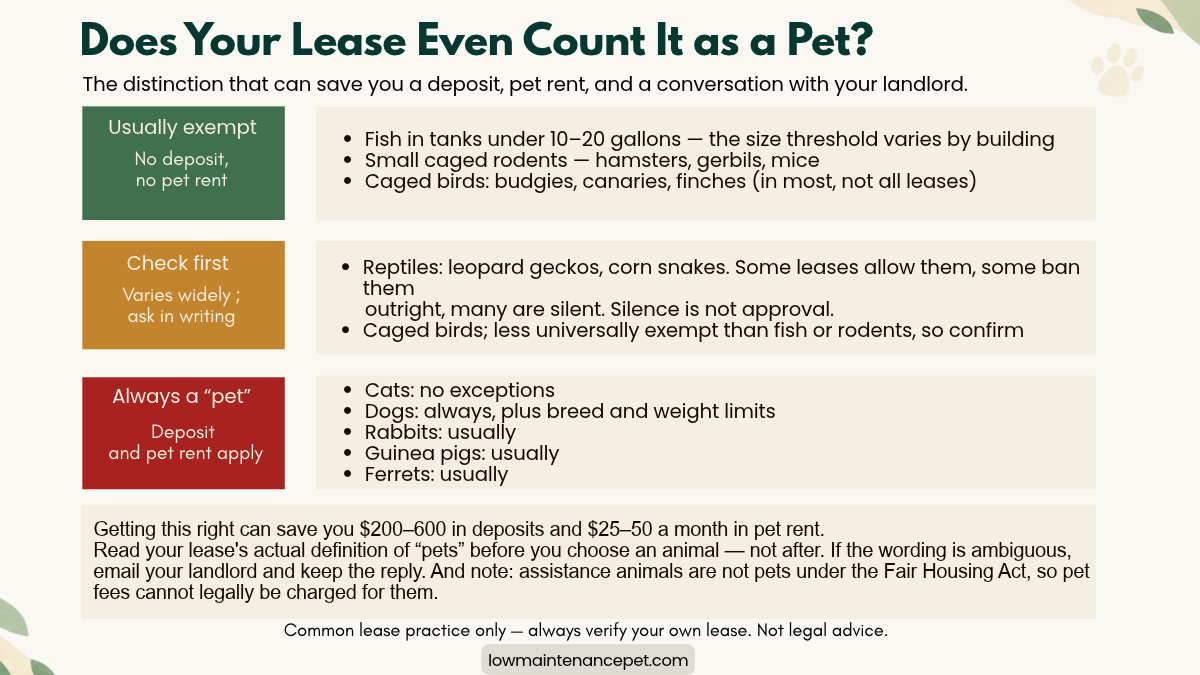
Many apartment leases explicitly exclude certain animals from their definition of “pets.” Most leases define “pet” narrowly, and the animals that fall outside that definition are usually the small, caged, contained ones: fish in tanks under 10–20 gallons, small rodents like hamsters and gerbils, and, in many leases, caged birds. Dogs and cats are always classified as pets. A landlord policy guide from Hemlane illustrates how narrowly these clauses are written, listing “dogs, cats, caged birds and fish under 20 gallons” as the categories a pet policy needs to specify.
Fish tanks under a certain size and small caged animals are frequently excluded from pet clauses entirely, meaning no pet deposit, no pet rent, no permission required, even in buildings that advertise as “no pets.”
This varies by lease and by state; always read your specific lease and confirm with your landlord in writing. But in general:
Usually NOT classified as “pets” in most leases:
- Fish in tanks under 10–20 gallons (the size threshold varies by building)
- Small caged animals: hamsters, gerbils, mice
- Caged birds: budgies, canaries, finches (in most, not all leases)
Usually classified as “pets” and subject to fees:
- Cats
- Dogs (always)
- Rabbits
- Guinea pigs
- Ferrets
- Reptiles (varies widely; some leases prohibit them explicitly)
This distinction can save you $200–600 in deposits and $25–50/month in pet rent. It’s worth understanding before you decide what to get.
One important exception: under the Fair Housing Act, assistance animals — service dogs and emotional support animals — are not legally “pets. Landlords cannot charge pet deposits or pet rent for them, even in buildings advertised as no-pets. If you have a documented assistance animal, everything above about fees does not apply to you. HUD guidance
Tier 1: Best Apartment Pets, Genuinely Low Footprint
Small space, quiet, minimal odor, low damage risk, and in many cases not classified as a pet in your lease.
Betta Fish: The Perfect Apartment Pet
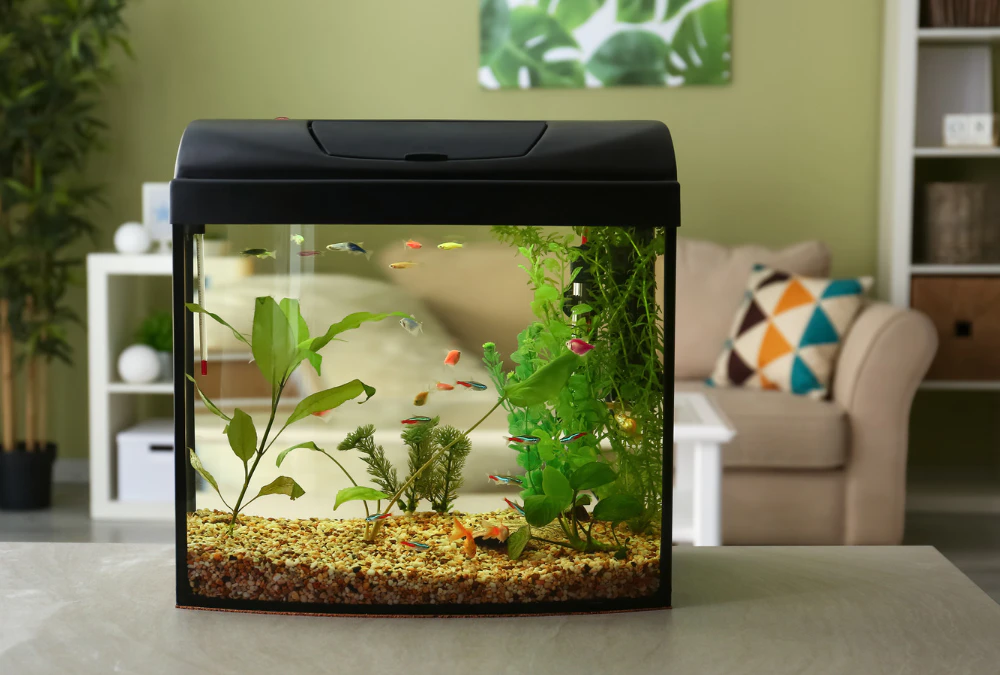
A betta fish in a 5–10 gallon tank is as close to a perfect apartment pet as exists. It takes up less than two square feet of floor space. It makes no sound. It produces no odor when properly maintained. It poses zero damage risk to your apartment. And in the vast majority of leases, it isn’t even classified as a pet, meaning no deposit, no pet rent, no conversation with your landlord needed.
Beyond the practical advantages, a betta tank provides genuine calm. A 2022 randomized controlled study in the Journal of Pediatric Nursing found that watching goldfish reduced anxiety and fear in hospitalized children. That is not the same as a controlled trial on adults at home, but if you’ve ever sat and watched a tank for ten minutes, you already know the effect is real.
Apartment suitability breakdown:
| Factor | Rating |
|---|---|
| Space requirement | ★★★★★ (2 sq ft) |
| Noise level | ★★★★★ (silent) |
| Odor risk | ★★★★★ (none if maintained) |
| Damage risk | ★★★★★ (zero) |
| Lease classification | Usually NOT a “pet” |
| Monthly cost | $7–23 |
| Setup cost | $80–250 |
| Daily time | ~2 min |
| Lifespan | 2–5 years |
Apartment tip: A planted betta tank (live aquatic plants) is the most visually striking version of this setup and has the added benefit of naturally filtering the water, reducing maintenance frequency, and adding greenery to a small space without the care requirements of houseplants.
Syrian Hamster: Maximum Pet in Minimum Space
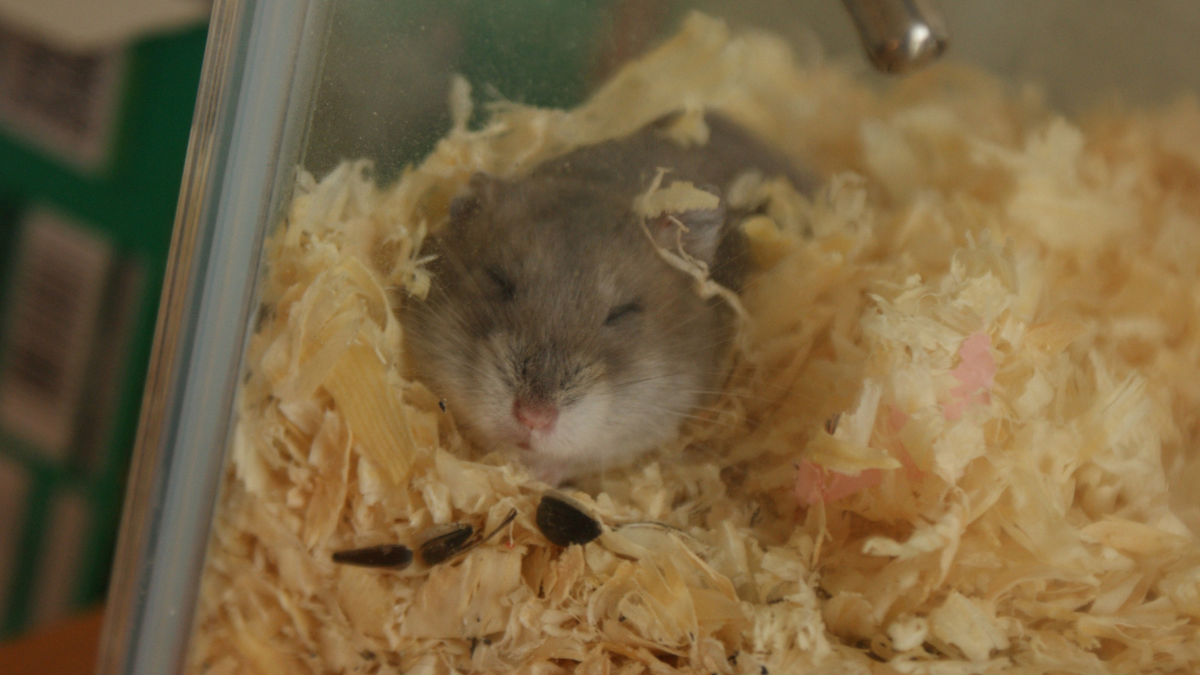
A Syrian hamster is genuinely one of the best-suited animals to apartment life. Their enclosure footprint is small — a proper setup takes about 3 square feet (450 square inches minimum), and they produce no noise during the day when you’re at work or sleeping. Their care routine- feeding and a water check in the evening- fits naturally into any schedule.
The apartment-specific advantages are real: hamsters don’t shed on your furniture, they don’t scratch floors, they don’t bark, and they don’t require outdoor access. In many leases, small caged rodents are not classified as pets.
The one apartment-specific consideration: hamsters are nocturnal and run their wheel at night. A cheap, squeaky wheel in a thin-walled bedroom apartment can be genuinely disruptive to you and potentially to your own sleep. A silent spinner wheel (Silent Runner, Niteangel, or equivalent) is not optional for apartment life. It’s a $20–30 investment that makes the difference between a pet you love and one that keeps you awake.
Apartment suitability breakdown:
| Factor | Rating |
|---|---|
| Space requirement | ★★★★★ (3 sq ft / 450 sq in min) |
| Noise level | ★★★★☆ (silent wheel required) |
| Odor risk | ★★★☆☆ (weekly full clean essential) |
| Damage risk | ★★★★★ (contained in cage) |
| Lease classification | Usually NOT a “pet” |
| Monthly cost | $15–30 |
| Setup cost | $100–250 |
| Daily time | ~5 min |
| Lifespan | 2–3 years |
⚠️ Wheel noise warning: A standard plastic wheel rattles noticeably on a hard surface and can be heard through walls. In an apartment; especially a studio this matters. Budget for a silent wheel before you budget for anything else in the hamster setup.
Leopard Gecko: The Ideal Quiet Reptile
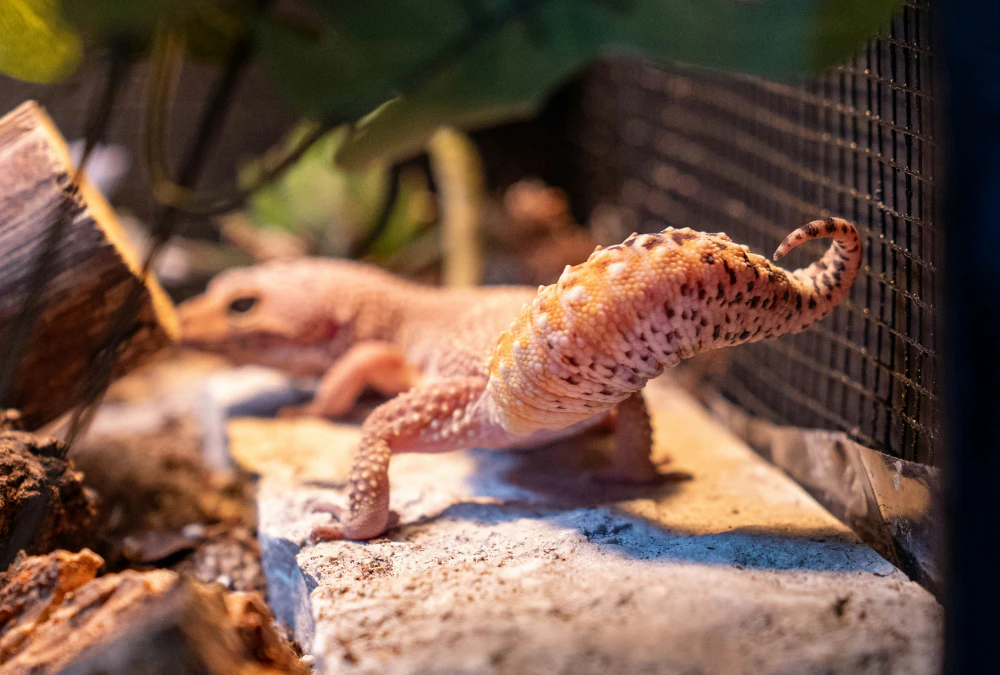
Leopard geckos are one of the most apartment-compatible animals available. Their enclosure, a 20-gallon tank minimum (40 is better for an adult), is compact and contained. They produce almost no body odor. They make virtually no sound; the only noise from a gecko setup is the faint hum of the thermostat-controlled heat mat, which is quieter than a refrigerator. They have zero damage potential to your apartment. And they feed only every other day as adults.
For apartment dwellers specifically, the gecko’s contained, self-sufficient nature is a major advantage. They don’t need outdoor time. They don’t need to roam your apartment. They don’t interact with your furniture, carpets, or walls. Their entire world fits in a 20-40 gallon tank that sits on a shelf.
Reptiles are classified as “pets” in some leases and explicitly prohibited in others. Check your lease specifically for language about reptiles before committing.
Apartment suitability breakdown:
| Factor | Rating |
|---|---|
| Space requirement | ★★★★★ (20-40 gal tank footprint) |
| Noise level | ★★★★★ (virtually silent) |
| Odor risk | ★★★★★ (daily spot-clean = no odor) |
| Damage risk | ★★★★★ (zero contained) |
| Lease classification | Check your lease; reptiles vary |
| Monthly cost | $30–60 |
| Setup cost | $160–300 |
| Daily time | ~5–10 min |
| Lifespan | 15–20 years |
⚠️ Lease check required: Some leases explicitly prohibit reptiles. Others have no language either way. Check yours; and get written confirmation from your landlord if the lease is ambiguous. Do this before purchasing.
Chinchilla: The Most Underrated Apartment Pet
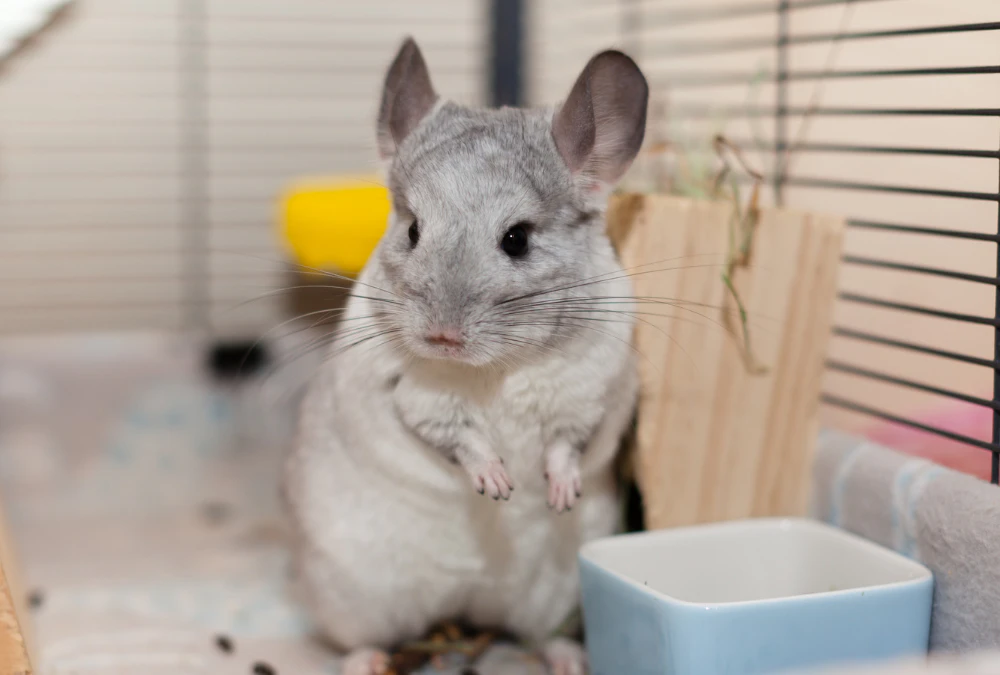
Chinchillas are rarely on apartment pet lists, which is a genuine oversight. They’re exceptionally low-odor (their dense fur doesn’t accumulate oils or secretions the way most rodent fur does), quiet outside of their active evening hours, contained within their enclosure, and produce no damage to your apartment.
Their one significant apartment-specific requirement: they cannot tolerate temperatures above 75°F (24°C). They overheat rapidly, and heat stroke can be fatal within hours. If your apartment doesn’t have reliable air conditioning in summer, a chinchilla is genuinely not safe for your space; no exceptions. In a climate-controlled apartment, they’re excellent.
Also important for welfare: chinchillas are social animals and do best in same-sex pairs or a neutered male/female pair. Two chinchillas take up the same space as one but are significantly happier; a happy chinchilla is quieter and less destructive.
Apartment suitability breakdown:
| Factor | Rating |
|---|---|
| Space requirement | ★★★★☆ (multi-level cage, ~4 sq ft footprint) |
| Noise level | ★★★★☆ (active evenings, occasional chewing sounds) |
| Odor risk | ★★★★★ (nearly odorless) |
| Damage risk | ★★★★☆ (chew risk if given free roam; keep supervised) |
| Lease classification | Caged rodent; often not classified as “pet” |
| Monthly cost | $40–70 per pair |
| Setup cost | $250–500 |
| Daily time | ~15 min |
| Lifespan | 10–15 years |
⚠️ Temperature is non-negotiable: Chinchillas cannot tolerate heat above 75°F (24°C). This is a hard limit, not a preference. If your apartment doesn’t have reliable, consistent air conditioning, a chinchilla cannot safely live there.
Tier 2: Good Apartment Pets, Manageable With the Right Setup
These animals work well in apartments but require more consideration of specific apartment constraints.
Budgies (Parakeets): A Pair
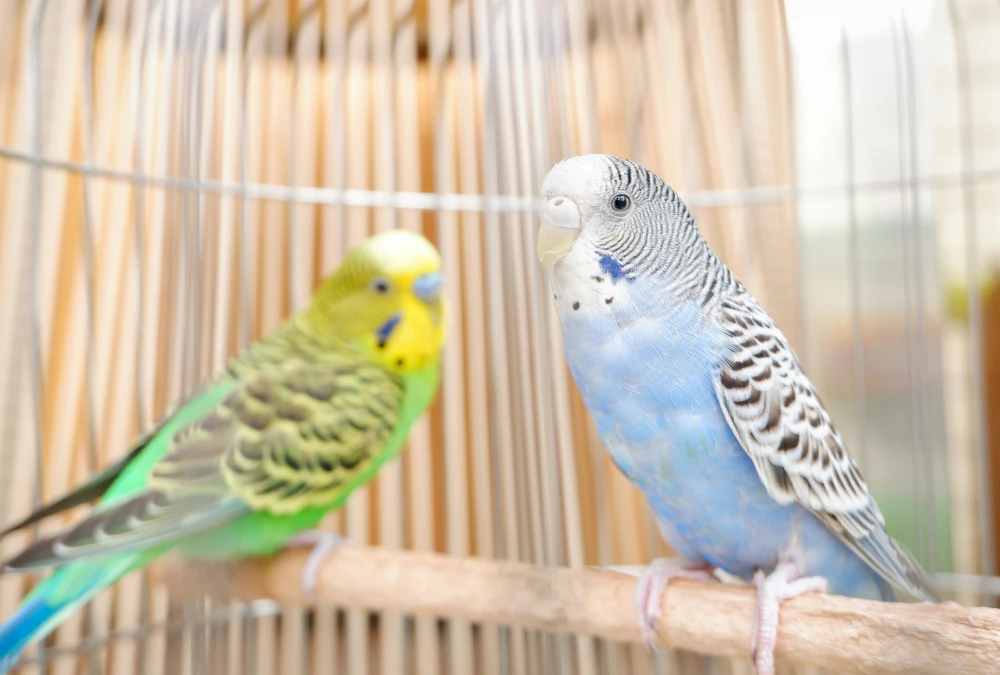
Budgies are genuinely good apartment pets, with one significant caveat that separates apartment life from house life: shared walls. Two budgies chattering during daylight hours produce a sound level roughly comparable to a TV on low volume. Most apartment neighbors won’t notice or won’t care. But if your walls are thin or your building has strict noise policies, it’s worth knowing this upfront.
The advantages for apartment dwellers are real: no fur on your furniture, no outdoor requirement, no floor damage, a small cage footprint (a proper budgie cage for two birds needs about 3 square feet of floor or shelf space), and genuinely low odor when the cage is maintained well. Many leases don’t classify caged birds as “pets”, but this varies more than with fish or small rodents, so confirm before bringing birds home.
They have out-of-cage time (ideally 1–4 hours daily), but it needs supervision in a small apartment to prevent them from chewing on curtains or houseplants (many common houseplants are toxic to birds) or from getting behind furniture, and, of course, check windows, mirrors, ceiling fans, and exposed wires before allowing a bird to explore.
Apartment suitability breakdown:
| Factor | Rating |
|---|---|
| Space requirement | ★★★★★ (3 sq ft cage footprint) |
| Noise level | ★★★☆☆ (audible daytime chirping; neighbors matter) |
| Odor risk | ★★★★☆ (low with regular cage cleaning) |
| Damage risk | ★★★★☆ (minimal if supervised during free time) |
| Lease classification | Caged birds; often not “pets,” but confirm |
| Monthly cost | $30–55 per pair |
| Setup cost | $150–300 |
| Daily time | ~10–15 min + supervised free time |
| Lifespan | 5–10 years, sometimes up to 15 |
⚠️ PTFE (Teflon-type) cookware warning: Birds are extremely sensitive to fumes released when PTFE-coated non-stick cookware is overheated. These fumes can cause severe respiratory distress and may be fatal within a short time. In a small apartment, especially one with an open kitchen layout, birds may be exposed more quickly because there is less separation between cooking areas and living spaces. Before bringing home a bird, consider replacing frequently used non-stick cookware with bird-safe alternatives such as stainless steel, cast iron, or 100% ceramic cookware, and ensure good kitchen ventilation.
Guinea Pigs: A Pair in the Right Space
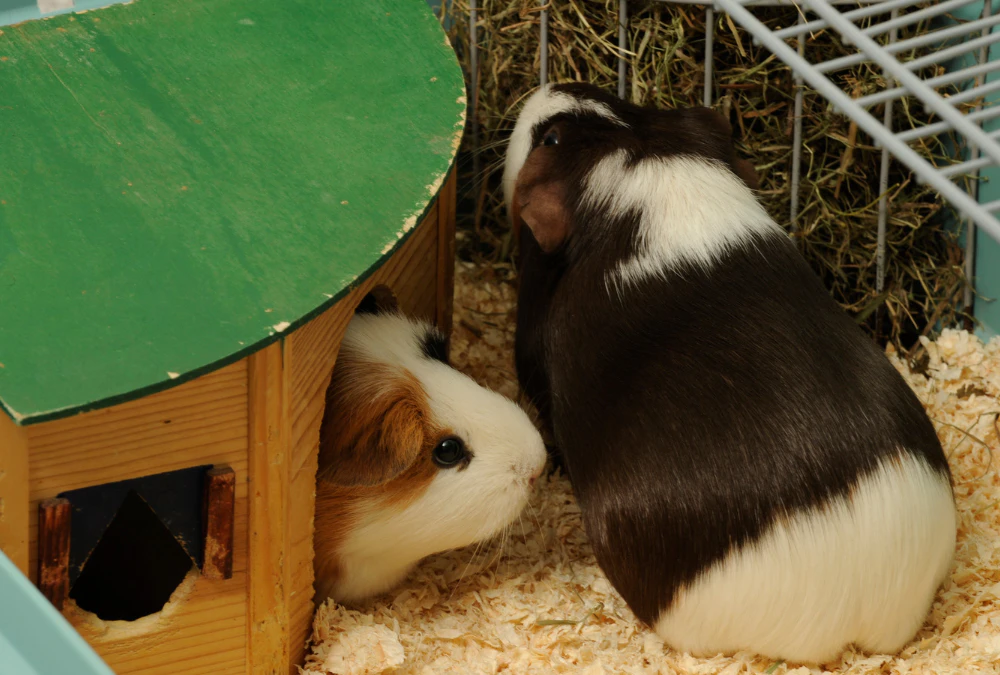
Guinea pigs are a surprisingly good fit for apartments for people who want a genuinely social, daytime-active mammal. They’re quiet; their squeak vocalization is audible but not loud enough to carry through walls in most buildings. They don’t need outdoor time. Their enclosure, properly sized (7.5–10.5 square feet for a pair; this is larger than many people expect), stays in one spot.
The apartment-specific challenges are worth knowing: guinea pigs are almost always classified as “pets” in leases and will typically incur a pet deposit and pet rent. Their enclosure is also bigger than you’d expect for a small pet; you need roughly the floor space of a coffee table, permanently, in a room that gets decent airflow.
The urine smell requires daily spot-cleaning and a full cage change every 5–7 days. In a well-ventilated apartment, this is manageable; in a studio with poor airflow, it requires more attention.
Apartment suitability breakdown:
| Factor | Rating |
|---|---|
| Space requirement | ★★★☆☆ (large cage footprint; coffee table sized) |
| Noise level | ★★★★☆ (quiet, occasional squeaks) |
| Odor risk | ★★★☆☆ (daily spot-cleaning essential in small space) |
| Damage risk | ★★★★☆ (contained; low damage when supervised) |
| Lease classification | Usually classified as “pet”; check fees |
| Monthly cost | $40–80 per pair |
| Setup cost | $200–400 |
| Daily time | ~15–20 min |
| Lifespan | 5–7 years |
💡 Apartment tip: A C&C cage (Cubes and Coroplast; modular wire panels with a corrugated plastic base) is the best guinea pig enclosure for apartment living. It’s completely customizable in shape, can be configured to fit your specific floor plan, is easy to clean, and ventilates better than a solid-sided enclosure; which matters significantly for odor control.
Corn Snake: Best For Occasional Travelers
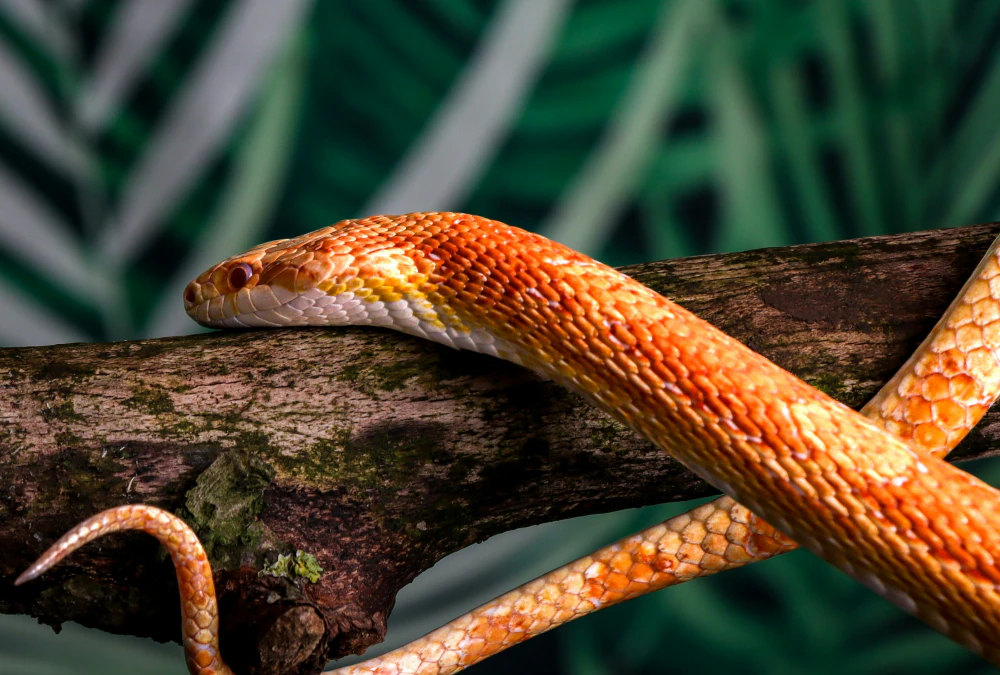
Corn snakes are exceptionally well-suited to apartment life from a practical standpoint: no noise, no odor, no outdoor requirement, no fur, no allergens, and an enclosure footprint of about 4 square feet for an adult. They feed only once every 7–14 days as adults, making them genuinely one of the lowest-maintenance hands-on pets available, including for people who travel occasionally.
The apartment-specific consideration is the lease. Reptiles are sometimes prohibited in leases, and snakes specifically may be called out. Check yours explicitly. Also worth knowing: corn snakes are escape artists. A 40-gallon tank with a locking, secure screen lid is non-negotiable. A corn snake loose in an apartment that you don’t find quickly becomes a corn snake inside your walls, under your appliances, or in your neighbor’s unit. This is not a scenario that ends well for your tenancy.
Apartment suitability breakdown:
| Factor | Rating |
|---|---|
| Space requirement | ★★★★☆ (40-gal tank for adults, ~4 sq ft) |
| Noise level | ★★★★★ (completely silent) |
| Odor risk | ★★★★★ (essentially odorless; enclosure cleaned weekly) |
| Damage risk | ★★★★★ (contained; zero apartment damage) |
| Lease classification | Check explicitly; reptiles vary widely |
| Monthly cost | $20–46 |
| Setup cost | $200–350 |
| Daily time | ~5 min check |
| Lifespan | 15–20 years |
⚠️ Escape prevention is critical: A corn snake with a loose or unsecured lid will escape. A locking screen lid is the single most important piece of equipment in the setup. Verify it every time you open the enclosure.
Tier 3: Possible, But Requires Careful Consideration
Rabbits: For the Right Apartment

Rabbits can be excellent apartment pets, but the gap between a rabbit setup done right and one done wrong is wide enough to cost you your deposit and your tenancy.
Done right: a rabbit that is litter-trained (most are), given a secure pen area, and properly rabbit-proofed is clean, quiet, and genuinely affectionate. Many apartment dwellers successfully keep rabbits and would recommend them.
Done wrong: a rabbit with unsupervised access to baseboards, electrical cords, carpet, and furniture is one of the most destructive apartment animals possible. Rabbits chew; it’s a biological need, not misbehavior. Cords, carpet corners, wooden furniture legs, and drywall are all targets. Rabbit-proofing means cable covers on every cord, furniture legs protected or blocked, and either hard flooring or area rugs you can afford to replace.
Their urine is also high in ammonia, stronger than most small animals, and the litter box must be cleaned every 1–2 days to prevent noticeable smell in a small space.
Apartment suitability breakdown:
| Factor | Rating |
|---|---|
| Space requirement | ★★★☆☆ (needs a pen + daily free roam) |
| Noise level | ★★★★★ (very quiet; rare thumping is their main sound) |
| Odor risk | ★★★☆☆ (litter every 1–2 days essential) |
| Damage risk | ★★☆☆☆ (HIGH if not rabbit-proofed; chews everything) |
| Lease classification | Usually classified as “pet”; deposits apply |
| Monthly cost | $60–100 |
| Setup cost | $300–600 |
| Daily time | ~20–30 min |
| Lifespan | 8–12 years |
Cats: The Classic Apartment Pet, With Caveats
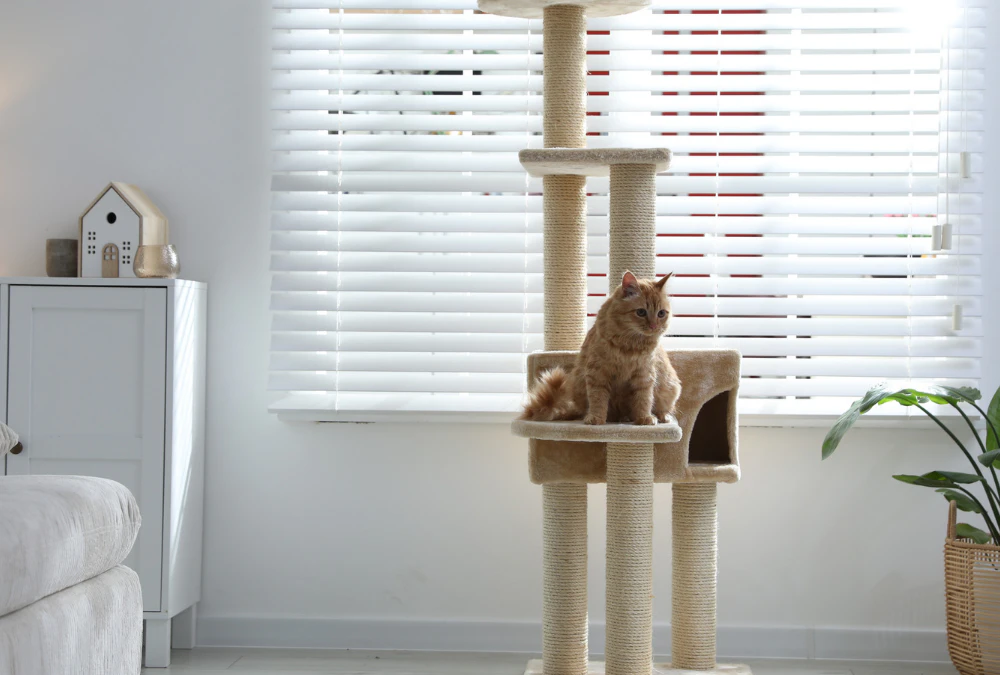
Cats are the most popular apartment pet for good reason: they’re independent, clean, quiet, and affectionate without being demanding. Most apartment leases allow cats with a pet deposit and monthly pet rent.
The honest apartment caveats that most guides skip: a cat in a small apartment needs genuine environmental enrichment, vertical space (cat trees, wall shelves), window access, and interactive play, or they become bored and destructive. A bored cat in a 400-square-foot studio can do meaningful damage: scratched furniture, shredded curtains, knocked-over decor. This isn’t the cat being bad; it’s the cat being a cat in an understimulating environment.
Litter box odor management is also more acute in a small space. You need at least one litter box; ideally two, even for one cat — and it needs scooping every 24–48 hours without exception in an apartment. A self-cleaning litter box is one of the best investments for apartment cat owners.
Cats are also always classified as pets in leases; no exceptions, and typically incur both a deposit and monthly pet rent.
Apartment suitability breakdown:
| Factor | Rating |
|---|---|
| Space requirement | ★★★☆☆ (needs vertical enrichment in small space) |
| Noise level | ★★★★☆ (quiet except during zoomies) |
| Odor risk | ★★★☆☆ (litter box must be scooped every 1–2 days) |
| Damage risk | ★★★☆☆ (scratching risk without proper alternatives) |
| Lease classification | Always a “pet”; deposits and pet rent apply |
| Monthly cost | $50–100 (food + litter + vet fund) |
| Setup cost | $200–400 |
| Daily time | ~15 min |
| Lifespan | 12–18 years |
💡 Apartment tip: A tall cat tree placed near a window is the single best investment for an apartment cat. It provides vertical space, a perch with a view (mental stimulation), and a scratching surface; solving three problems at once.
Pets to Avoid in Apartments: Honest Reasoning
Dogs: Most Don’t Work in Small Apartments
Dogs are not on the low-maintenance list for apartments, and the reasoning is worth spelling out. Dogs need outdoor time multiple times a day, at minimum 3–4 bathroom trips for an adult dog, plus exercise. In an apartment without a yard, every bathroom break is a trip through hallways, elevators, and outdoor spaces. Puppies need significantly more frequent trips. A dog that doesn’t get adequate exercise in a small apartment becomes destructive, vocal, and anxious.
Some breeds genuinely work in apartments; typically calm, low-energy breeds like retired greyhounds, Cavalier King Charles Spaniels, Shih Tzus, or Basset Hounds. French Bulldogs are often suggested too, but their flat faces come with real breathing and health problems worth researching first. But even these require daily outdoor time and owner commitment that fall well outside the “low maintenance” category.
If your heart is set on a dog and you live in an apartment, research breeds honestly, commit to two daily walks minimum, and consider a dog walker for mid-day breaks if you work full-time.
Ferrets: Not Appropriate for Small Apartments
Ferrets have a persistent body odor that comes from their skin, not just their enclosure. In a small, enclosed apartment space, this smell is genuinely significant and not eliminable through cleaning alone. They also require several hours of supervised free-roaming time daily and will get into and under everything in your apartment. Not a good fit for small spaces or smell-sensitive buildings.
Large Parrots (Macaws, Cockatoos, African Greys)
Large parrots are intelligent, social, and beautiful, and completely incompatible with apartment living. Their noise levels (screaming is a natural behavior, not a training failure) are genuinely disruptive through walls and across floors. African Greys and cockatoos particularly can reach 80–100 decibels at full volume. In any apartment building, this is a neighbor conflict waiting to happen.
The Real Cost of Having a Pet in an Apartment: 2026 Figures
This is the section of the guide that most apartment pet articles skip entirely. Before you bring an animal home, you need to know the full financial picture.
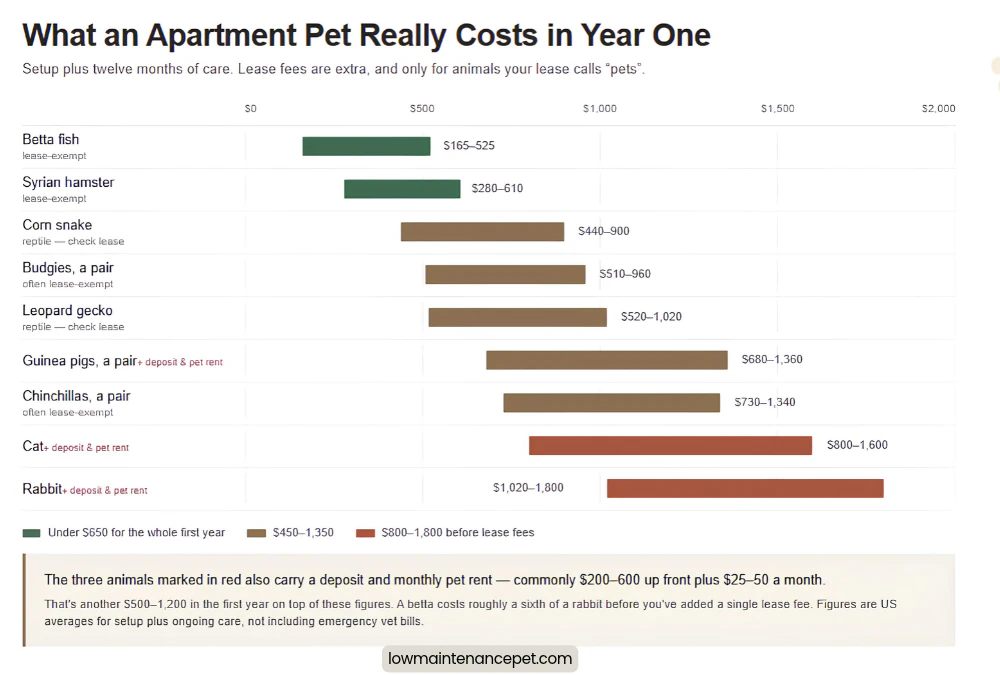
Lease costs: what landlords charge in 2026:
According to RentLateFee.com (2026) and LeaseRunner (2026), the national averages are:
| Pet fee | One-time, non-refundable | $200–500 per pet |
| Pet deposit | One-time, refundable if no damage | $200–600 per pet |
| Pet rent | Monthly addition to base rent | $25–50/month national average |
Animals that typically avoid these costs:
Fish in tanks under the size specified in your lease, small caged rodents (hamsters, gerbils), and caged birds are frequently excluded from pet definitions. A hamster costs you nothing in lease fees at most buildings, just the animal’s own monthly costs of $15–30. That difference compounds significantly over time.
Damage risk costs: what to factor into your budget:
| Fish | Virtually none (contained) | $0 |
| Hamster/Gecko/Snake | Essentially none (contained) | $0 |
| Cat | Scratching, carpet, furniture | $100–500 |
| Rabbit | Chewing cords, carpet, baseboards | $200–800 |
| Dog | Scratching floors, chewing, accidents | $300–1,500+ |
These aren’t scare figures; they’re what you’re putting on the line with your security deposit. A pet that does no damage costs you nothing extra. A pet that damages your apartment costs you your deposit and potentially additional charges.
Apartment Pet Checklist: Before You Bring Anything Home
Work through every item on this list before committing to an animal:
Lease and landlord:
- [ ] Read your lease’s specific definition of “pets”; does it exclude fish, caged animals, or birds?
- [ ] Confirm any pet restrictions on species, size, or number
- [ ] Get written confirmation from your landlord if anything is ambiguous
- [ ] Understand what fees apply and budget for them upfront
- [ ] Check if renters insurance covers pet damage (many policies don’t)
Space assessment:
- [ ] Measure where the enclosure will go; does it fit without crowding essential furniture?
- [ ] Is there a window nearby for light (reptiles, birds) or viewing (fish)?
- [ ] Is the temperature in that spot stable? (Avoid spots near drafts, vents, or direct heat)
- [ ] Do you have reliable air conditioning if you’re considering a chinchilla?
Neighbor impact:
- [ ] How thin are your walls? Have you heard neighbors through them?
- [ ] Does your building have quiet hours? What time do they start?
- [ ] Is the animal’s noise level (if any) compatible with your specific building?
Lifestyle match:
- [ ] Who is the backup caretaker if you travel or get sick?
- [ ] Are you home enough to meet this animal’s social needs?
- [ ] Have you budgeted the full first-year cost including setup, fees, and a vet emergency fund?
Quick Comparison Table
| Pet | Space Needed | Noise Level | Odor Risk | Damage Risk | Usually Exempt from “Pet” Fees? | Monthly Cost |
|---|---|---|---|---|---|---|
| Betta Fish | ★★★★★ | Silent | Very low | Zero | ✅ Usually yes | $7–23 |
| Syrian Hamster | ★★★★★ | Silent (needs a silent wheel) | Low–medium | Zero | ✅ Often yes | $15–30 |
| Leopard Gecko | ★★★★★ | Silent | Very low | Zero | ⚠️ Check lease | $30–60 |
| Chinchilla (pair) | ★★★★☆ | Low (evening activity) | Very low | Low (if supervised) | ✅ Often yes | $40–70 |
| Budgie (pair) | ★★★★★ | Low–medium (daytime) | Low | Very low | ⚠️ Often yes, confirm | $30–55 |
| Guinea Pig (pair) | ★★★☆☆ | Low (occasional wheeks) | Medium | Very low | ❌ Usually “pet” | $40–80 |
| Corn Snake | ★★★★☆ | Silent | Very low | Zero | ⚠️ Check lease | $20–46 |
| Rabbit | ★★★☆☆ | Very quiet | Medium | High (chewing) | ❌ Usually “pet” | $60–100 |
| Cat | ★★★☆☆ | Low–medium | Medium (litter) | Medium (scratching) | ❌ Always “pet” | $50–100 |
“Pet fee exemption” column reflects common lease practices; always verify your specific lease. Monthly costs cover ongoing care only; excludes pet fees, deposits, and pet rent charged by landlords.
FAQ: Questions Renters Actually Ask
What is the best pet for a small apartment?
For the smallest footprint with the fewest lease complications: a betta fish. It takes up two square feet, produces no noise, has virtually no odor, costs $7–23/month ongoing, and is not classified as a “pet” in the vast majority of leases. For someone who wants a hands-on animal, a Syrian hamster is the next step: similar lease advantages, minimal space, and manageable daily care. For someone who wants a reptile, a leopard gecko offers the same contained, quiet, low-odor profile in a 20-gallon tank.
What pets are allowed in most apartments?
Fish (especially in tanks under 20 gallons) and small caged animals (hamsters, gerbils) are the most universally permitted, often not even classified as “pets” under lease terms. Caged birds are frequently allowed but less universally than fish. Most pet-friendly buildings allow cats, usually with fees. Dogs depend heavily on the building, the breed, and the weight limit. Reptiles vary widely; some buildings explicitly prohibit them, while others say nothing about them at all. Always check your specific lease before bringing any animal home.
Can I have a pet in a no-pets apartment?
It depends on what “pet” means in your lease. Many no-pets leases still don’t prohibit fish tanks under a certain size or small caged animals, because they aren’t classified as “pets” under the lease’s definition. Read the exact language of your no-pets clause carefully. If your lease says “no dogs or cats,” a hamster may be fine. If it says “no animals of any kind,” that’s a different situation. Get written clarification from your landlord before bringing anything home; never assume.
What is the cheapest pet to have in an apartment?
A betta fish is the cheapest: $7–23/month in ongoing costs, typically $0 in lease fees, and an $80–250 one-time setup cost. A Syrian hamster is next at $15–30/month, also typically fee-exempt. Both are significantly cheaper than any “pet” category animal (cat, dog, guinea pig, rabbit) that incurs pet deposits, pet rent, and higher monthly care costs.
What pets can be left alone for 8 hours while I’m at work?
Fish, leopard geckos, hamsters (who sleep during the day anyway), and corn snakes handle 8+ hours alone with no issue. Guinea pigs and budgies manage a workday fine if they have a same-species companion. Cats handle 8 hours well in most cases. Dogs generally cannot; they need bathroom access every 4–6 hours and suffer behaviorally when left alone all day without adequate stimulation.
Do apartments allow reptiles?
It depends entirely on the lease. Some leases explicitly prohibit reptiles. Some allow small caged reptiles. Many have no specific language either way, which creates ambiguity. The critical rule: always ask in writing before you bring a reptile home. If your lease is silent on reptiles and you get verbal permission, follow up with an email to create a written record. Never assume silence means approval; discovering a prohibited reptile during an inspection can be grounds for lease termination.
What is the quietest pet for an apartment?
Fish produce no sound whatsoever. Leopard geckos and corn snakes are completely silent; the only sound from their setup is the faint hum of a heat source. Syrian hamsters are silent during the day (they sleep) and produce wheel noise at night, which a silent-spinner wheel eliminates. Rabbits are extraordinarily quiet; their main sound is an occasional thump when startled or displeased, which travels through floors but not walls. Cats are quiet most of the time. Dogs and birds are the noisiest common pets; birds during the day, dogs at any time.
How do I pet-proof my apartment for a rabbit?
Rabbit-proofing an apartment covers five main areas:
(1) Electrical cords: cover all exposed cords with cable management conduit or flex tubing. A chewed cord is a fire hazard, and a rabbit can die from electrocution.
(2) Baseboards: use clear plastic guards along the base of walls where the rabbit has access.
(3) Carpet edges: place furniture over the edges or use carpet protectors; rabbits target loose carpet corners.
(4) Furniture legs: protect wooden legs with plastic or fabric covers.
(5) Houseplants: many common houseplants are toxic to rabbits; move all plants out of reach. This takes an afternoon to set up properly and prevents most deposit damage.
Conclusion
The best apartment pet isn’t the one with the most personality or the most impressive setup; it’s the one that genuinely fits your space, your lease, your neighbors, and your lifestyle without creating problems on any of those fronts.
For a no-fuss, lease-safe, genuinely low-cost choice: a betta fish. The single best apartment pet for someone who wants calm, beauty, and zero complications.
For the best small hands-on mammal in a lease-restricted building: a Syrian hamster with a silent wheel. Simple care, minimal space, typically lease-exempt.
For the best contained reptile in a quiet apartment: a leopard gecko. Virtually silent, odorless, requires no outdoor time, and is fascinating to observe and handle. Check your lease first.
For the most social, interactive animal in a reasonable-sized apartment: a pair of guinea pigs in a well-ventilated space; or a pair of budgies if your walls can handle gentle daytime chirping.
For renters who want a cat or rabbit: both are possible in apartments, but both require real thought about deposit risk, lease costs, and the specific constraints of your space. Go in with eyes open and a plan for each challenge.
Whatever you choose: read your lease first, get confirmation in writing, and budget the full first-year cost including fees and a vet emergency fund. The animals on this list are genuinely good apartment companions when they’re matched to the right home.